
How many tiles to start with
What 36 pieces build, where 60 stops being enough, and why the answer changes the moment a second child sits down. Counted against the sets we actually make.
This is the question we get most, and the honest answer is that it depends on how many hands are on the rug. A box that keeps one four-year-old busy for an hour runs out in ten minutes when a sibling joins. So here is the arithmetic, worked out against the sets we make rather than against a round number someone picked.
What one house costs in pieces
A house that stands up needs four walls and a roof. Four squares make the walls. Two triangles lean together into a pitched roof, or one square lies flat for a flat one. Call it six pieces for a house a toddler recognises as a house. Add a door, a chimney and a garden wall and you are at ten.
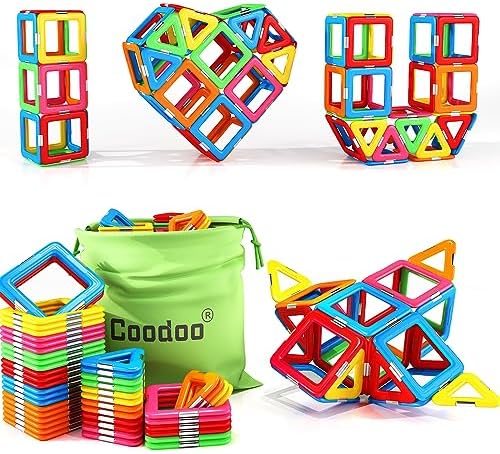
Our 36 piece tin breaks down as 14 squares, 12 equilateral triangles, 6 right triangles and 4 isosceles. That is three houses worth of squares and a lot of roof, which is exactly the shape of most first hours: build a house, knock it flat, build a better one.
Where each size runs out
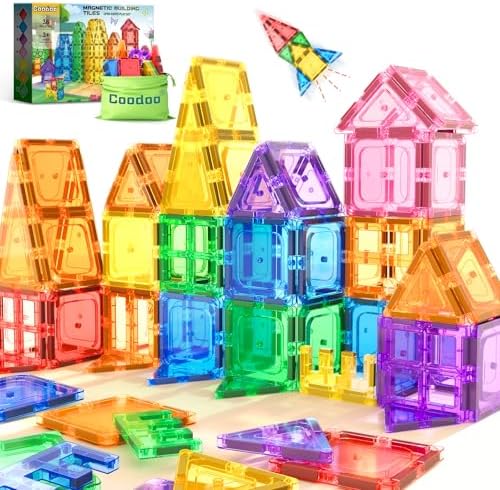
Our smallest full boxes sit at 36 and 40 pieces. One child, one build at a time, and the tower comes down before the next one goes up. At 60 the child stops dismantling to keep going, which is the point where play gets longer rather than louder. At 70 and 100 two children can work on separate builds without negotiating over the last square. Our largest boxes run to 194 pieces, and those are for a floor, not a table.
What a box costs climbs close to evenly with the piece count. There is no size where the pieces get cheaper by the dozen, so two small boxes and one big one land in much the same place. The difference is the shapes: the big boxes carry pieces the small ones do not.
If you are buying a second box
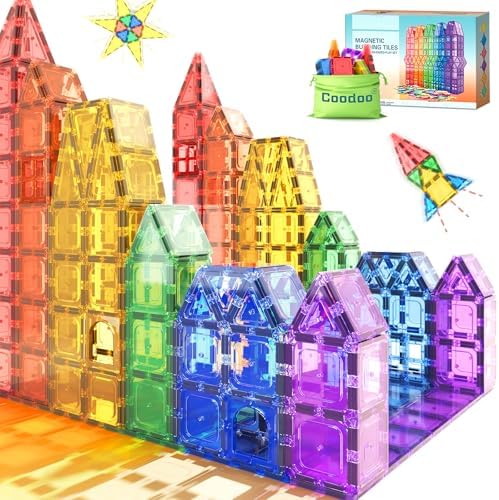
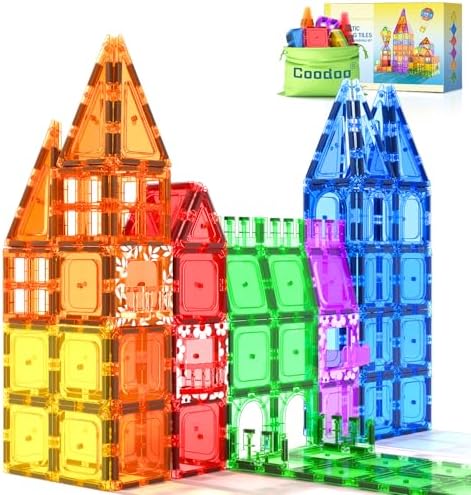
Buy for shapes, not for count. A pile that is all squares and triangles builds houses, and after a fortnight the houses stop being interesting. What changes the game is a set with a different silhouette in it: a castle wall, a jointed dinosaur, a printed window card. Our castle boxes and dinosaur boxes both sit on the same square base, so they land in the existing pile rather than starting a second one.
The short version
One child under four, 36 to 40 pieces. One child who has done this before, 60. Two children, 100. A classroom or a birthday floor, everything you can find. Our piece count helper asks four questions and lands on the same answer with the boxes attached.
Boxes to start a floor
The boxes this note is about, in order of how many people have bought them.
The other notes
Written from the same floor.
What is actually inside one of our tiles
Plastic, magnets, and how the two are held apart. What our boxes state about materials, sealing and age grading, and the one check worth doing yourself.
On the rugMixing our tiles with the ones you already own
The three inch base, what it means for a pile that came from somewhere else, and the one size of ours that will not join in.
On the rugFive builds for the first week
What to show a child on day one so the pile does not become a pile. Five builds in order of difficulty, each one out of squares and triangles.
After the buildKeeping a set in one piece
Where the pieces go at the end of the day, why the bag matters more than the shelf, and what to do about the tile that went under the sofa in March.